

WHY WE EXIST
THE PLASTIC PROBLEM
“Medical experts are becoming increasingly aware that exposure to microplastics, nanoplastics, and common hormone-disrupting chemicals such as bisphenols and phthalates may have a greater impact on our health than we previously recognized. While there is still much to learn, the research is growing and it is increasingly concerning, not only for our own health, but for the health of our children, who may be even more vulnerable to these chemicals due to their still-developing bodies.”
—Dr. Dawn Mussallem
DO, Chief Medical Officer of Fountain Life, Double Board Certified Lifestyle Medicine Physician and Longevity Expert
A NEW OUAI FORWARD
The everyday packaging that we've grown accustomed to makes ridding our homes of microplastics next to impossible—much less our bodies. One of the biggest culprits? Bottled water.
Whether you drink it from plastic, aluminum or glass, chances are you’re also ingesting microplastics, nanoplastics and other chemicals like phthalates, bisphenols (like BPA), and PFAS.

PLASTIC
33% of Americans (~112 million) drink plastic-bottled water daily.
22 million children drink water from plastic bottles every single day.
~240,000 microplastics are found in an average liter of bottled water.

STANDARD CANS
ALUMINUM
BPA-free is not equal to bisphenol-free.
Several bisphenol analogues are used as replacements to BPA in can liners.
~ 140 microplastic particles are found in an average liter of water in an aluminum can with a screw cap.

GLASS
Carries 2-3x MORE microplastics than plastic.
Metal caps shed paint fragments into water.
Sources: Qian, N., Gao, X., Lang, X., Deng, H., Bratu, T.M., Chen, Q., Stapleton, P., Yan, B., & Min, W. (2024). Rapid single-particle chemicalimaging of nanoplastics by SRS microscopy. Proceedings of the National Academy of Sciences. Bleich, S.N. & Vercammen, K.A. (2018). Trends in tap andbottled water consumption among children and adults in the United States: analyses of NHANES 2011–16 data. Nutrition Journal. Rosinger AY, Herrick KA, Wutich AY, Yoder JS, Ogden CL. Disparities in plain, tap and bottled water consumption among US adults: National Health and Nutrition Examination Survey (NHANES) 2007-2014. Public Health Nutr. 2018 Jun;21(8):1455-1464. Reininger, N., Oehlmann, J. Regrettable substitution? Comparative study of the effect profile of bisphenol A and eleven analogues in an in vitro test battery. Environ Sci Eur 36, 76 (2024). Jaye Marchiandi, Wejdan Alghamdi, Sonia Dagnino, Mark P. Green, Bradley O. Clarke,Exposure to endocrine disrupting chemicals from beverage packaging materials and risk assessment for consumers,Journal of Hazardous Materials,Volume 465,2024. Yuqi Wang, Yunxiang Wang,Assessing microplastic contamination in soda beverages: A Multi-city, Multi-container laser Direct infrared spectroscopy study,Heliyon,Volume 10, Issue 12,2024. Iseline Chaïb, Périne Doyen, Pauline Merveillie, Alexandre Dehaut, Guillaume Duflos,Microplastic contaminations in a set of beverages sold in France,Journal of Food Composition and Analysis,Volume 144,2025. Welle F, Franz R. Microplastic in bottled natural mineral water - literature review and considerations on exposure and risk assessment. Food Addit Contam Part A Chem Anal Control Expo Risk Assess. 2018 Dec;35(12):2482-2492. Weisser, J.; Beer, I.; Hufnagl, B.; Hofmann, T.; Lohninger, H.; Ivleva, N.P.; Glas, K. From the Well to the Bottle: Identifying Sources of Microplastics in Mineral Water. Water 2021, 13, 841. Testing conducted by Eurofins Analytical Laboratories.
THE SUPERCAN SOLUTION
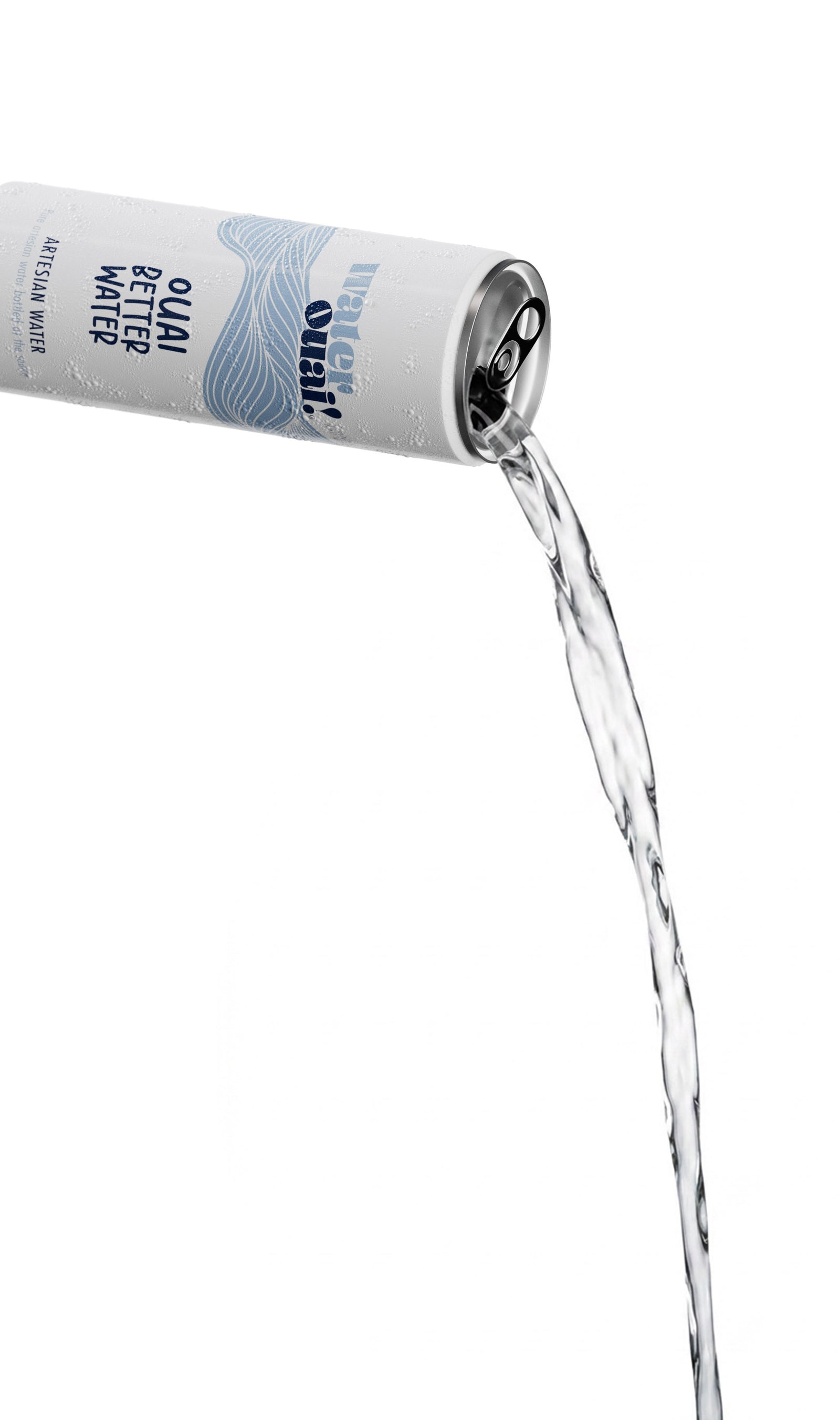
We knew there had to be a better way — after all, doesn’t clean water deserve clean packaging? Our WaterOuai! Supercan™, is a super custom aluminum can that’s engineered with a liner that introduces no microplastics, bisphenols (like BPA), or phthalates into your water.
Grab some popcorn and see what we mean…

SIP-WORTHY
Water as nature intended…
Our H2O is natural artesian water sourced from the Edwards Aquifer in the Texas Hill Country, one of the most remarkable groundwater systems in the world. As a karst aquifer, the water flows through an intricate network of limestone and dolomite deposits and is naturally filtered and mineralized along the way.
The result is clean, crisp alkaline water that’s smooth and balanced without being heavy and metallic. And because of where the aquifer is situated (between impermeable geological layers), it’s naturally protected from surface contamination, requiring fewer interventions between the source and your sip.